What an Agent Actually Costs: Cost per Completed Task, Not Cost per Token
- Oct 13, 2026
AI Cost Optimization | By the Zylen Solutions Team | 3-minute read
AI has never been cheaper to buy. TNW reports that GPT-4-class performance has fallen from about $20 per million tokens in late 2022 to about $0.40, a 98% drop. Yet AI bills keep climbing. Since July, every Microsoft division has had an AI token spending cap, and engineers can watch their own usage on an internal dashboard.
Both things are true at once. The unit got cheaper, and the work got far hungrier. Autocomplete sends one prompt and gets one answer. An agent plans, calls tools, reads what comes back, tries again and checks its own work. Every one of those steps is another model call, and every call carries the whole conversation so far.
Why price per token is the wrong number
- Context is re-sent every step. A 20-step task can send the same instructions and history to the model twenty times.
- Tool output becomes input. Search results, files, logs and API responses all count as tokens on the next call.
- Failed runs still bill. A task the agent abandons, or one a person has to redo, costs as much as one that worked.
- One model does everything. Simple steps like formatting or classifying often run on the most expensive model by default.
None of this shows up in a price per token. It shows up in the invoice.
The number to track instead
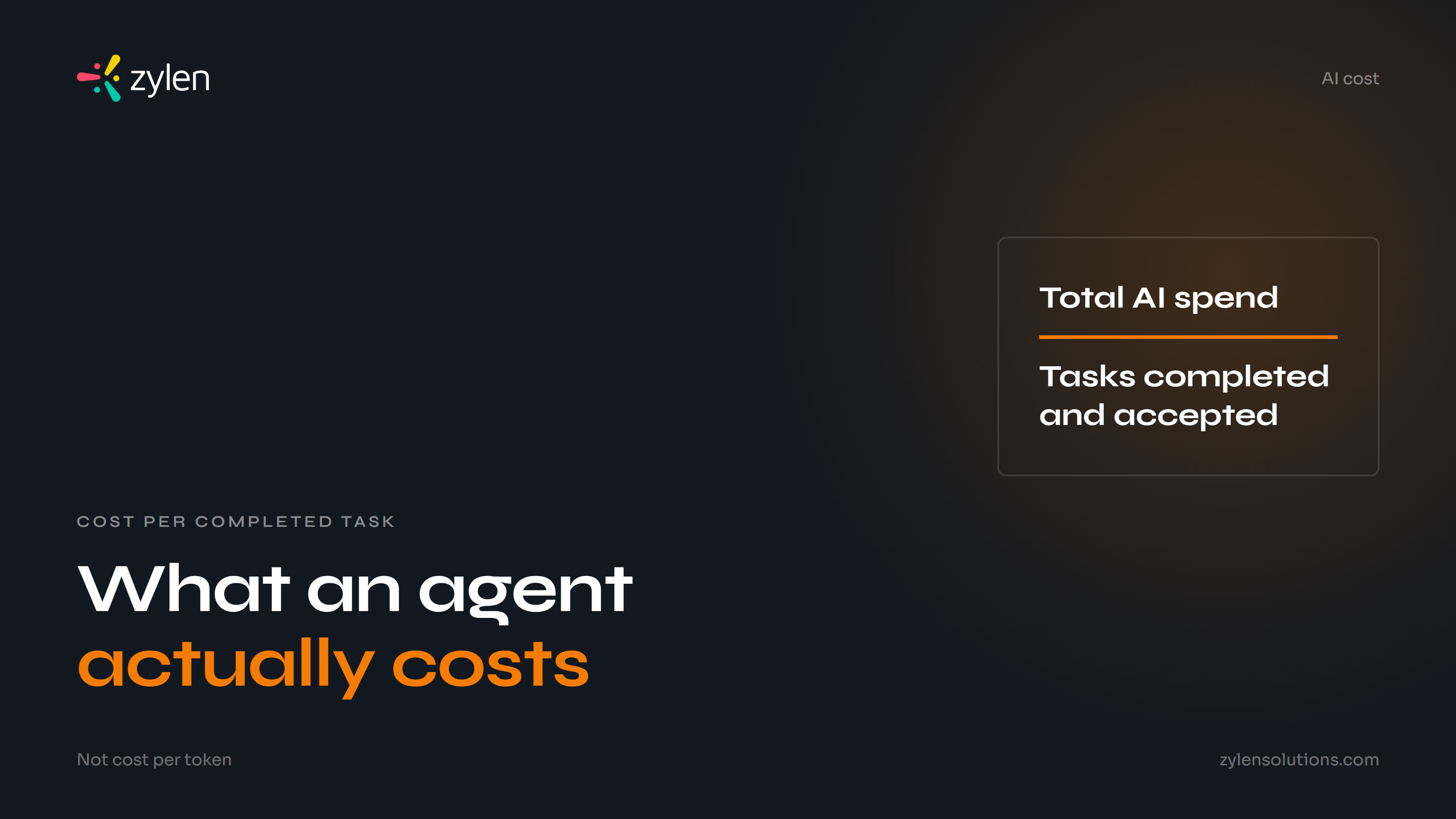
Cost per completed task = total AI spend ÷ tasks completed and accepted
"Completed and accepted" is the important part. Count only the tasks a person or downstream system accepted without redoing them. And count everything on the spend side: model calls, retries, embeddings and the infrastructure the agent runs on.
Illustrative example: a support-triage agent costs $18,000 a month and handles 12,000 tickets. If 7,500 are resolved without a person redoing the work, the cost per completed task is $2.40, not the $1.50 that dividing by every ticket suggests. The 4,500 tickets that came back cost money and delivered nothing.
Three levers that move it
- Model routing. Send simple steps to smaller, cheaper models and keep the strongest model for planning and hard reasoning. Check quality with evals before and after the switch.
- Caching. Major providers bill cached input at a fraction of the normal input price. Stable instructions, tool definitions and reference documents are the first candidates.
- Step budgets. Cap the steps and tokens a task can use. When a task hits the cap, hand it to a person instead of letting it loop.
Measure accepted output every time you pull a lever. It is possible to cut the cost per token and still raise the cost per completed task, for example when a cheaper model sends more work back for rework.
How we approach it at Zylen
Zylen is an AI optimization partner. We work inside the AI systems companies already run. We meter what each workflow costs per completed task, change one thing at a time, and keep the before-and-after on record so every result can be checked. We don't quote a generic savings percentage. The only number that counts is yours, measured.
If your AI bill is growing faster than the work it delivers, start with our ten-day AI Optimization Audit.
See where your AI spend goes: start the AI Optimization Audit
Sources: TNW, "Token prices fell 98%…" (Jun 5, 2026); TNW, "Microsoft tells employees to stop tokenmaxxing…" (Aug 4, 2026).
About Zylen
Zylen is an engineering firm working on AI cost, security and sovereignty. We meter what inference actually costs, put guardrails in front of AI systems, and run open models inside our customers' own infrastructure.
Recent Posts
What an Agent Actually Costs: Cost per Completed Task, Not Cost per Token
Zylen Solutions Joins Anthropic's Claude Startups Program
9 Seconds to Zero: The 5 Guardrails Every AI Agent Needs Before Production
Your AI Pilot Works. So Why Isn’t It in Production?
Categories
- AI Cost Optimization
- Company News
- AI Engineering
- Healthcare IT
Newsletter
Contact us
Have a project in mind? We would love to hear from you.
Send