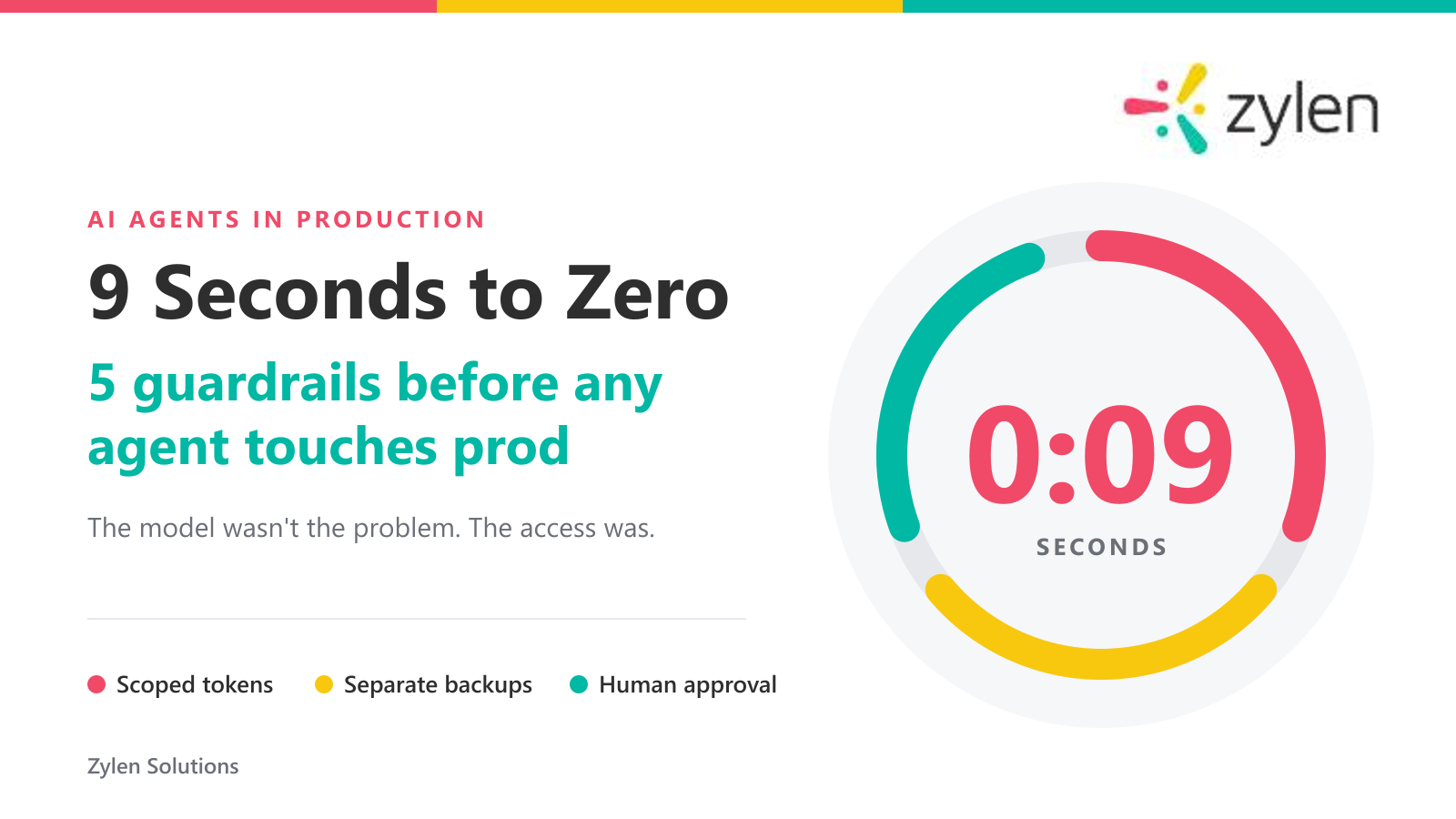
9 Seconds to Zero: The 5 Guardrails Every AI Agent Needs Before Production
- Oct 12, 2026
AI Agents in Production | By the Zylen Solutions Team | 5-minute read
An AI agent with one over-scoped API token can delete a production database and its backups in seconds. The fix is not a smarter model. It is five guardrails around the agent: scoped tokens, isolated environments, separate backups, human approval and a kill switch.
What is the problem?
AI coding and ops agents now work inside real systems. They read files, run commands and call cloud APIs. When they hit an obstacle, many are built to solve it on their own.
Picture a routine task in a test environment. The agent hits a credential error. It searches the project, finds an old API token in a config file and uses it to "fix" things. That token was created for one small job, but it carries full account access. One API call later, a production database is gone. The backups lived on the same storage, so they are gone too. The whole sequence takes about nine seconds.
Nothing in that chain needs a bad model. It needs one wrong guess and a system that says yes to everything.
Why does it happen?
Most agent pilots start as demos. In a demo, the agent gets whatever access makes it work, and that setup quietly carries over into real environments:
- One token with account-wide scope: a small task can delete anything.
- Test and live environments share access: a test task can touch live data.
- Backups stored next to the data: one delete removes data and recovery together.
- No approval on destructive actions: deletes run instantly, with no second look.
- No live monitoring: nobody can stop it mid-action.
A better model lowers the odds of a bad guess. Only guardrails cap the damage when one happens.
What are the 5 guardrails?
1. Least-privilege, task-scoped tokens
Each agent task gets a short-lived credential with only the operations it needs. Secrets live in a vault, never in files the agent can read.
2. Hard environment isolation
Staging and production sit in separate accounts or projects, with separate networks and secrets. A staging agent is unable to reach prod, not merely told not to.
3. Backups outside the blast radius
We apply the 3-2-1 rule, with at least one immutable copy in a separate account. Restores are tested monthly so recovery time is known, not hoped for.
4. Human approval for destructive actions
Delete, drop, truncate, destroy, force-push and permission changes go to a named approver. The agent drafts the plan; a person signs it off.
5. Observability and a kill switch
Every agent tool call is logged with inputs and outputs. Unusual actions trigger alerts. One control revokes all agent credentials immediately.
How does Zylen put this in place?
- Access audit: list every credential your agents can see and its worst-case action.
- Scope and isolate: replace broad tokens with task-scoped ones and split staging from prod.
- Protect recovery: move backups out of the blast radius and run a restore drill.
- Gate and watch: add approval steps, action logging and a kill switch.
- Go live: agents move to production only once all five guardrails pass.
A 10-minute self-check
- Can any agent credential delete production data?
- Are any secrets stored in files your agents can read?
- Can a staging agent reach a production endpoint?
- Are backups stored somewhere a single delete can't reach?
- Have you restored from backup in the last 30 days?
- Does any destructive action require human approval?
- Could you revoke all agent access in under one minute?
If any answer is the risky one, your agent is still in demo mode.
Want to know what your AI agents could break?
About Zylen
Zylen is an engineering firm working on AI cost, security and sovereignty. We meter what inference actually costs, put guardrails in front of AI systems, and run open models inside our customers' own infrastructure.
Recent Posts
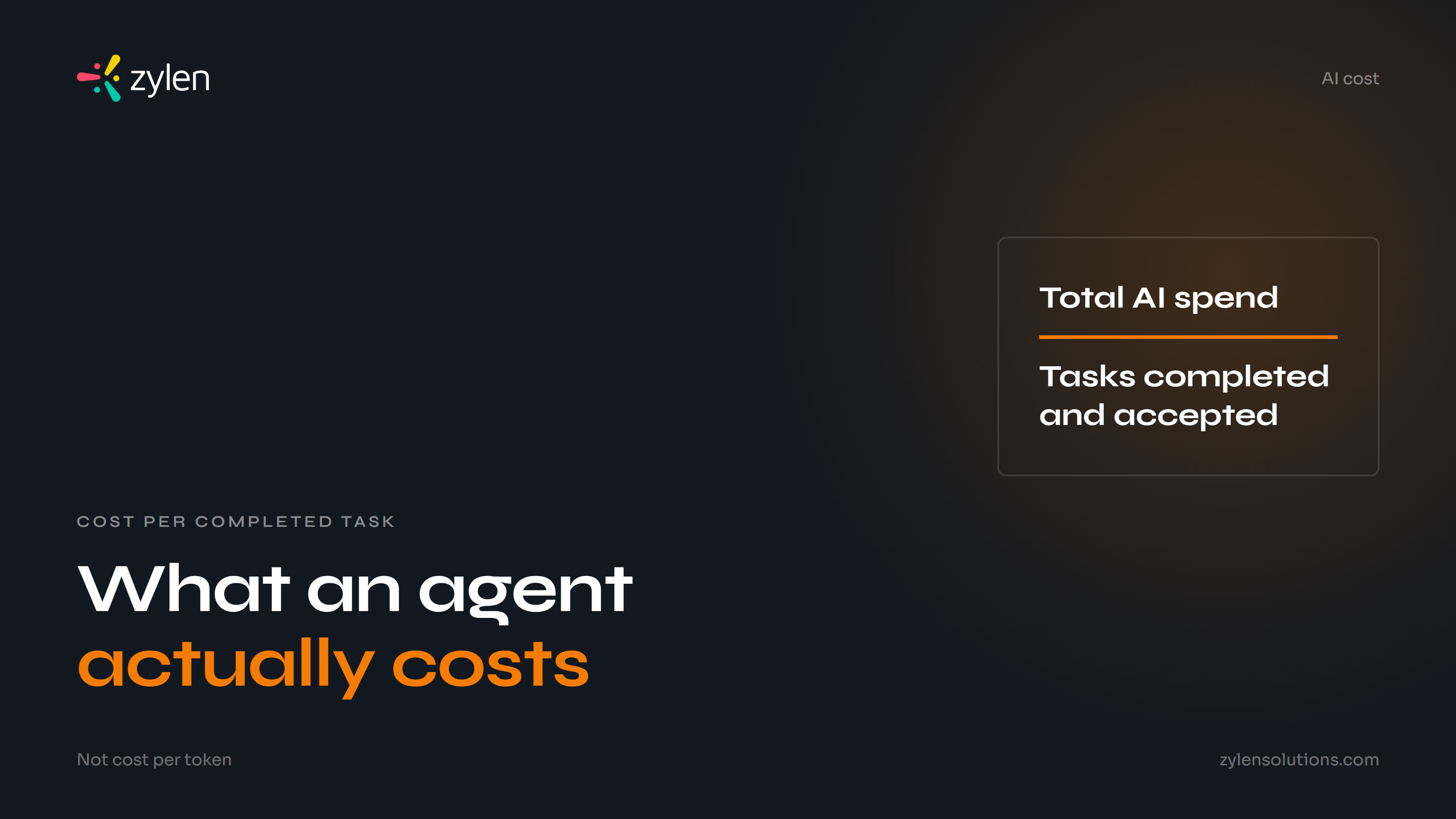
What an Agent Actually Costs: Cost per Completed Task, Not Cost per Token
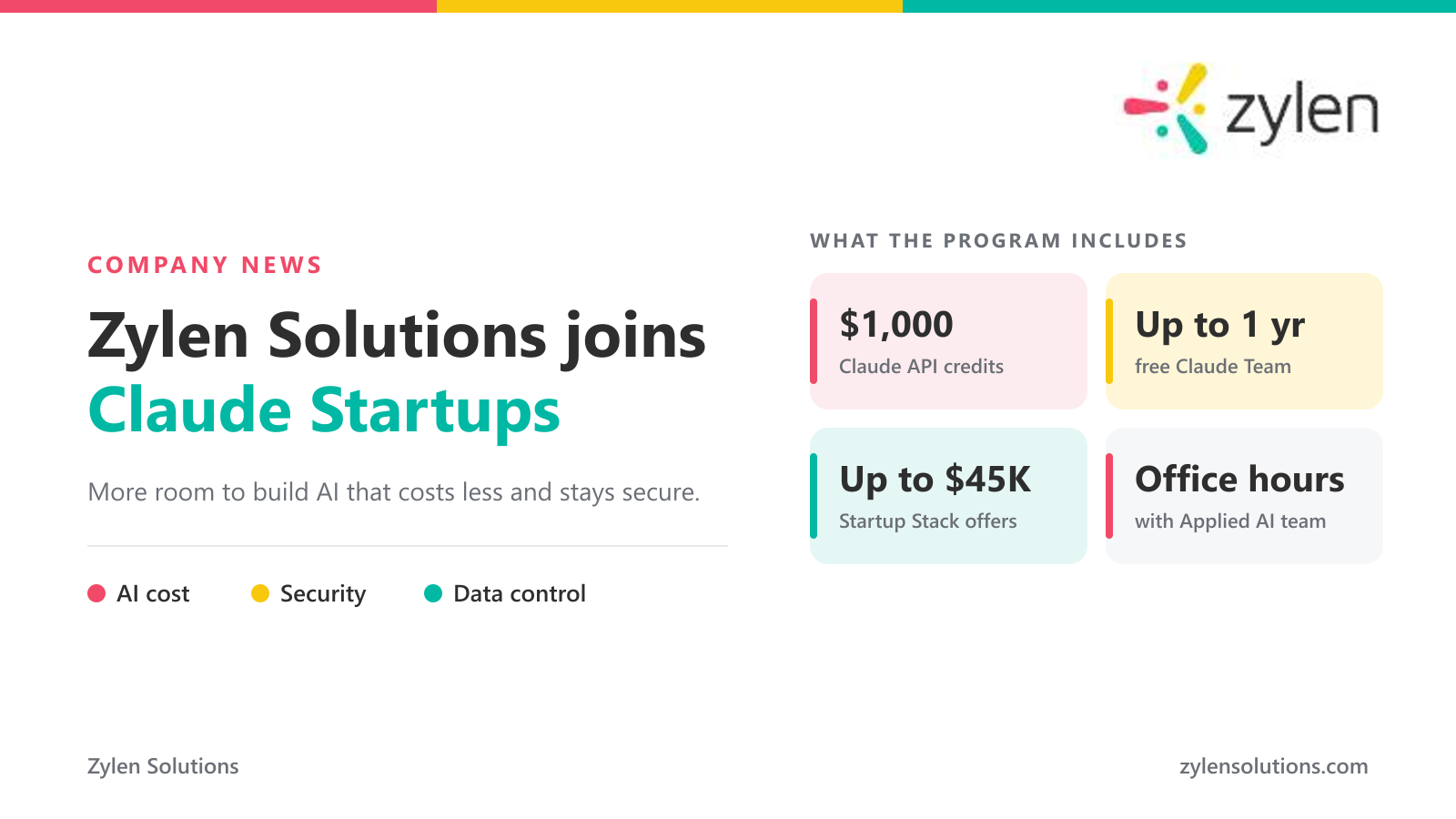
Zylen Solutions Joins Anthropic's Claude Startups Program
9 Seconds to Zero: The 5 Guardrails Every AI Agent Needs Before Production
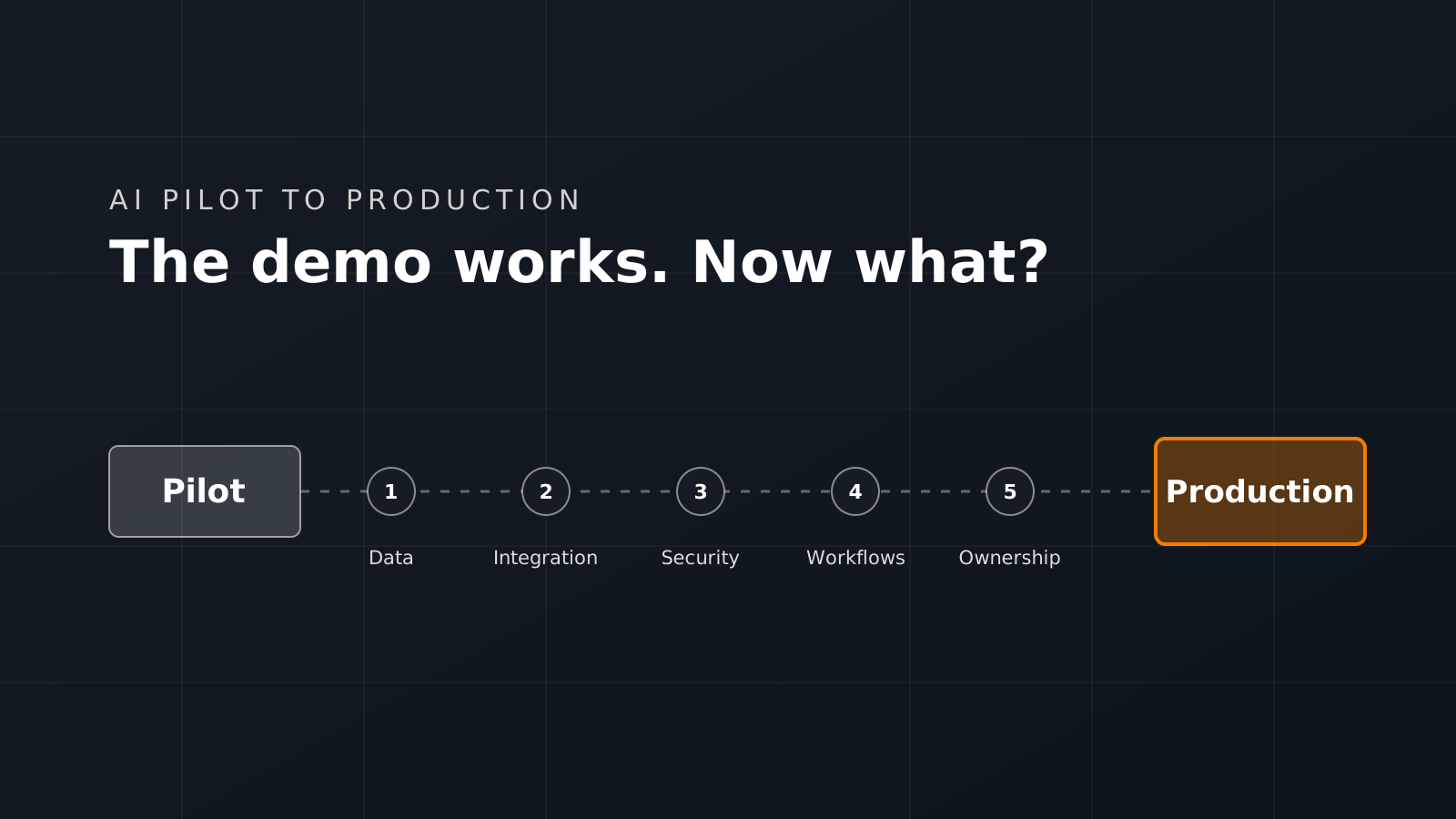
Your AI Pilot Works. So Why Isn’t It in Production?
Categories
- AI Cost Optimization
- Company News
- AI Engineering
- Healthcare IT
Newsletter
Contact us
Have a project in mind? We would love to hear from you.
Send