Why Cost Per Million Tokens Is a Useless KPI for Enterprise AI
- Sep 17, 2026
Your LLM provider just cut token prices by 50%. Your AI system can still become more expensive.
That is not a paradox. It is what happens when the unit you are billed in stops matching the unit your business buys. Token price is an input cost. It tells you what inference costs. It does not tell you what a successful AI-generated business outcome costs.
Most enterprise AI cost programs we see start in the wrong place: a spreadsheet comparing providers on dollars per million tokens, followed by a migration, followed by a bill that did not move the way anyone expected. The model got cheaper. The workflow did not.
Cost Per Token Is Not Cost Per Outcome
AI cost optimization is the process of reducing the total cost of producing reliable AI outcomes, not merely reducing the price paid per token.
Cost per million tokens is a model-pricing metric. It is useful for exactly one decision: comparing two providers for the same call, with the same prompt, at the same quality. Enterprises rarely face that decision in isolation.
The questions a CTO or FinOps lead actually needs answered look nothing like a price sheet:
- What does this AI workflow cost end to end?
- What does one successfully completed task cost?
- Which product, team or customer segment generates that spend?
- How much of the bill comes from retries?
- How much comes from context we did not need to send?
- Are frontier models being called for classification work a small model would handle?
- What does retrieval add? What do tool calls add?
- Are agents entering loops that produce no additional value?
- Which workloads could run on smaller, open or private models?
- Did last quarter's cost reduction quietly degrade task quality?
Token price answers none of them.
AI Agents Broke Traditional LLM Cost Accounting
Early LLM usage was simple enough to reason about on a napkin:
User → Prompt → Model → Response
One call in, one response out. Token volume was roughly proportional to conversation length, and cost per interaction was stable enough that a price comparison was a reasonable proxy for a cost comparison.
Agentic systems removed that proportionality. A single user request now looks closer to this:
User request → Agent → Model → Reasoning → Retrieval → Model → Tool call → API or database → Model → Validation → Retry → Model → Outcome
Every arrow can be a billable event. Reasoning iterations re-send accumulated context. Retrieval adds embedding calls and vector queries. Tool execution adds third-party API charges and compute. Validation adds another model pass. A retry repeats most of the chain, and the system prompt is paid for again on every hop.
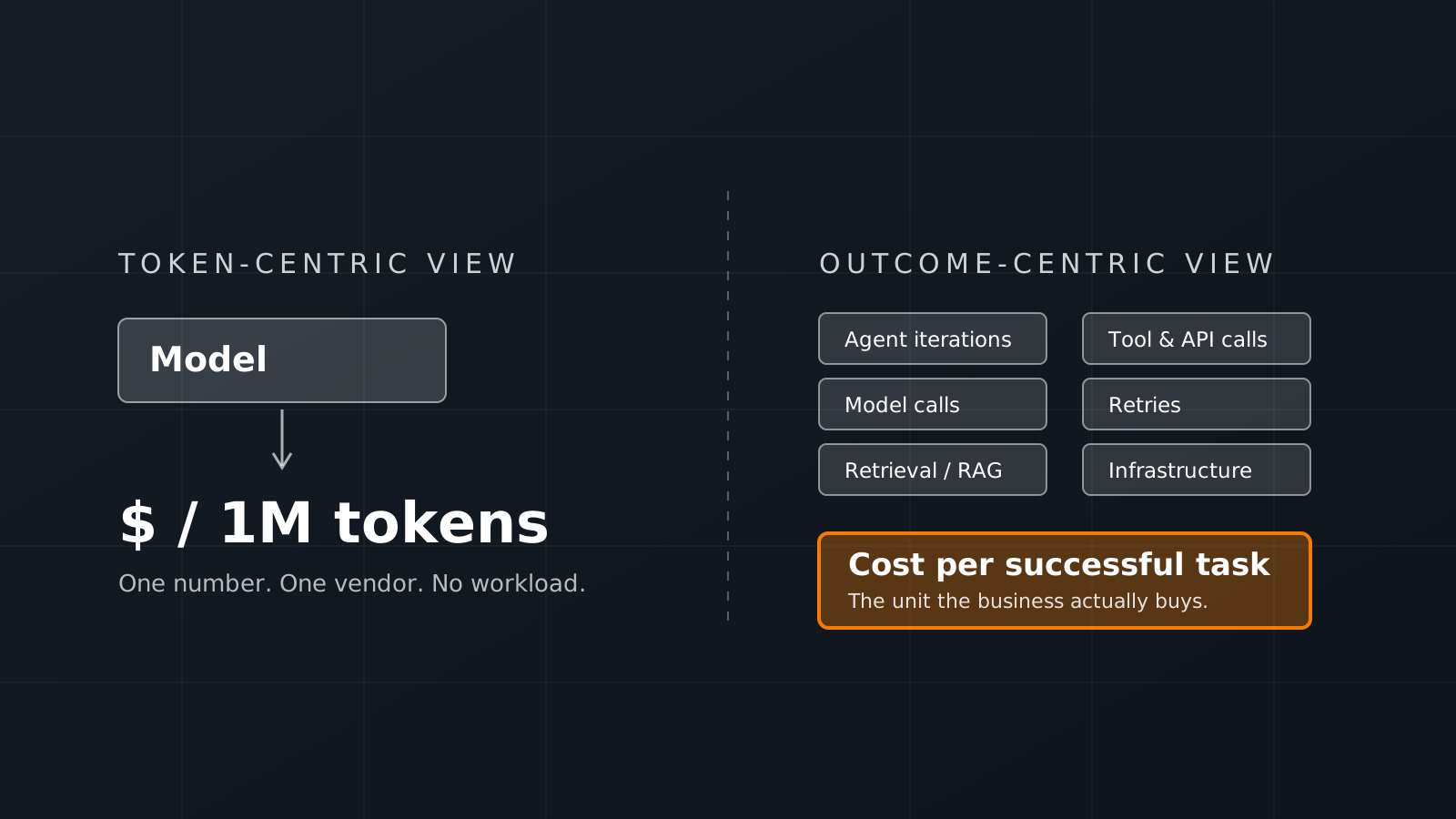
Token-centric view
Model
↓
$ / 1M tokens
One number. One vendor. No workload.
Outcome-centric view
Business task
↓ agent iterations
↓ model calls
↓ retrieval and RAG
↓ tool and API calls
↓ retries
↓ infrastructure
Successful outcome
Cost per successful task
The cheapest model does not necessarily create the cheapest workflow. It creates the cheapest call.
An Illustrative Example: Two Agents, One Task
The numbers below are illustrative and constructed to make the arithmetic visible. They are not measured Zylen customer results.
Two agents perform the same task. Agent A runs on a cheaper model but needs more orchestration to get there.
| Attribute | Agent A | Agent B |
|---|---|---|
| Blended model price | $0.40 / 1M tokens | $1.50 / 1M tokens |
| Reasoning and retry loops | 5 | 1 |
| Retrieval operations | 3 | 1 |
| Tool and API calls | 4 | 2 |
| Task completion rate | 82% | 96% |
On the price sheet, Agent A is 3.75 times cheaper. Now add the assumptions the price sheet leaves out. Assume Agent A's loops accumulate 60,000 tokens per attempt while Agent B's single pass uses 18,000; retrieval costs $0.0008 per operation; each tool call costs $0.0020; and orchestration compute is $0.0040 per attempt for A and $0.0015 for B.
| Cost component (per attempt) | Agent A | Agent B |
|---|---|---|
| Model inference | $0.0240 | $0.0270 |
| Retrieval | $0.0024 | $0.0008 |
| Tool and API calls | $0.0080 | $0.0040 |
| Orchestration compute | $0.0040 | $0.0015 |
| Cost per attempt | $0.0384 | $0.0333 |
| Cost per successful task | $0.0468 | $0.0347 |
Two things happen. First, the 3.75x price advantage disappears at the inference line alone, because Agent A burns 3.3 times the tokens. Second, dividing by the completion rate (0.0384 ÷ 0.82 against 0.0333 ÷ 0.96) puts Agent B roughly 26% cheaper per successful outcome.
And that still understates the gap. Agent A fails 18% of the time against Agent B's 4%. Those failures are paid for twice: once in inference, and again in whatever handles them downstream, which is usually a human.
Change the assumptions and the answer changes. That is the point. The result depends on token volume, loop behavior and success rate, none of which appear on a pricing page.
The Hidden Cost Stack Behind an AI Task
A defensible AI cost figure accounts for the components the workload actually uses:
Model inference + input/output tokens + agent iterations + retries + embeddings + vector database and retrieval + tool and API calls + compute and infrastructure + observability + failed executions = AI workflow cost
Not every architecture contains every component. A single-call summarization feature has no agent loop and no vector database. A document-processing agent may spend more on OCR and tool execution than on inference. A high-volume classifier may find that observability and data egress are material line items.
The relevant components are a property of the workload, not of the vendor. Which is why they have to be measured per workload rather than assumed from a reference architecture.
The Cheapest Model Can Be the Most Expensive Architecture
Benchmark tables and price lists reward the wrong comparison. They compare models in isolation, on standardized prompts, without the orchestration the model will actually run inside.
A stronger model that succeeds on the first attempt, needs less scaffolding, retries less, requires less retrieved context and makes fewer tool calls can be cheaper per successful outcome than a model that costs a quarter as much per token.
The inverse is equally true, and matters more for cost reduction. Smaller and open models can be dramatically more economical for workloads where they clear the required quality threshold. Classification, extraction, routing, tagging, summarization of short documents and structured transformation are frequently in that category, and frequently running on frontier models because that is what the first prototype used.
So the optimization question is not "which model is cheapest?" It is: what architecture delivers the required outcome at the lowest reliable cost?
The KPI That Matters: Cost Per Successful Task
One metric reframes the whole conversation:
Cost per successful task = total AI workflow cost ÷ number of successfully completed tasks
The denominator is the part that does the work. Failed attempts stay in the numerator, because you paid for them, and leave the denominator, because they produced nothing.
"Task" is a business definition, not a technical one:
| Workload | Unit of value |
|---|---|
| Customer support | Cost per successfully resolved ticket |
| Developer agent | Cost per accepted code change |
| Document processing | Cost per correctly processed document |
| Healthcare workflow | Cost per successfully completed workflow |
| Sales AI | Cost per qualified outcome |
The principle underneath all of them: tie AI cost to the unit of value the system is supposed to produce. Once that number exists, model selection, prompt design and architecture decisions stop being matters of opinion.
Attribute AI Spend to Teams, Features and Workflows
A single monthly provider invoice is not a cost model. It is a total. Totals cannot be optimized because they cannot be argued with.
Useful attribution runs down the hierarchy:
Organization → Team → Product → Feature → Workflow → Model → Task → Outcome
With that chain instrumented, the questions become answerable:
- Which feature consumes the largest share of AI spend?
- Which team generates the most failed AI calls?
- Which workflow has a retry rate well above the others?
- Which customer segment creates disproportionate inference cost relative to revenue?
- Where are frontier models being used for work a smaller model handles?
- Which agent has the highest cost per successful task?
This is the practical content of AI FinOps: not a dashboard of aggregate spend, but the ability to trace a dollar to the workflow that spent it and the outcome it did or did not produce. It is also the prerequisite for chargeback, for AI-spend budgeting and for deciding which optimization is worth engineering time.
How Enterprises Can Actually Reduce AI Costs
Once the meter exists, the levers are mostly unglamorous.
Model Routing
Not every request needs the most capable model. A classifier in front of the workload can route by task complexity:
Request → classification / router → simple task to a smaller model, complex task to a frontier model, sensitive workload to a private model, failure to a fallback route
Routing usually delivers more than renegotiating token prices, because it changes the mix rather than the rate. It also needs a fallback policy and a quality gate, or it becomes a quiet quality regression.
Prompt and Context Optimization
Context is the most commonly overpaid line item. Typical waste includes system prompts re-sent in full on every agent hop, entire conversation histories replayed when a summary would do, retrieval returning ten documents where three are relevant, and output formats far larger than the consumer needs.
None of this is exotic engineering. It is measurement followed by deletion.
Caching
Semantic and response caching avoids paying repeatedly for equivalent work. It applies cleanly where inputs recur and answers are stable, such as policy lookups, product questions and repeated document types. It applies badly where responses are personalized, time-sensitive or regulated. Cache hit rate belongs on the dashboard next to cost, because a cache nobody hits is just latency.
Agent Iteration Budgets
Uncontrolled loops are the most expensive failure mode in agentic systems, and the easiest to bound. Give every execution explicit limits:
- maximum reasoning iterations
- maximum retries
- maximum tool calls
- a cost ceiling per execution
- a defined fallback or human escalation path when a limit is hit
An agent that escalates at the budget is cheaper than an agent that loops to a timeout, and considerably easier to reason about.
Smaller and Open Models
For workloads that clear the quality bar, moving from frontier to smaller or open models is often the single largest reduction available. The condition is the quality bar. Evaluate on your own cases, not on a public benchmark.
Never optimize cost independently of quality.
Private AI
Some workloads benefit from private or self-hosted deployment for reasons that start with data control, regulatory exposure and customization, and end with economics. High, steady volume amortizes reserved compute well. Spiky or low-volume traffic usually does not.
Private AI is not automatically cheaper. API pricing buys elasticity and zero operational burden; private deployment buys predictability, control and a fixed cost base you have to keep busy. Treat it as a workload-specific calculation, and include the operational cost of running inference infrastructure on the private side of the ledger.
Never Optimize Cost Without Measuring Quality
A 60% cheaper architecture is not an optimization if task success collapses. It is a cost transfer to whoever cleans up the output.
Every change should move through the same loop:
Baseline → change → evaluation → cost comparison → quality comparison → accept or reject
The evaluation set should be built from your own production cases, and the quality threshold agreed with the business owner before the change ships. Useful guardrail metrics include task success rate, accuracy against a labelled set, human acceptance or override rate, hallucination and error rate, P95 latency, reliability, and the downstream business outcome the workflow feeds.
If a change cannot be evaluated, it cannot be released as an optimization. It is a bet.
The Enterprise AI Cost Scorecard
If your AI program reports only monthly spend, this is the gap. Each row is a metric an enterprise AI platform team should be able to produce on demand.
| Metric | Why It Matters |
|---|---|
| Monthly AI spend | Overall baseline |
| Cost per successful task | Business efficiency |
| Cost by model | Model economics |
| Cost by team, product and feature | Attribution and accountability |
| Average agent iterations per task | Loop efficiency |
| Retry rate | Wasted execution |
| Cache hit rate | Reuse efficiency |
| Frontier-model usage % | Routing opportunity |
| Failed-task cost | Direct waste |
| P95 latency | User experience constraint |
| Quality / task success rate | Optimization guardrail |
Most teams can produce the first row immediately and the second row not at all. That asymmetry is the whole problem.
From Token FinOps to AI Outcome Economics
This is not a fringe position. The broader AI FinOps discussion has been converging on the same conclusion: token pricing is an input, and value has to be expressed in units the business recognizes, such as cost per user, cost per task and AI spend as a share of revenue.
The MLOps Community podcast episode "Why Cost Per Million Tokens Is A Useless KPI?" makes the argument from inside a large enterprise practice, with Kuntal Patel and Abhinav Lad, who lead cloud FinOps and cloud and AI finance at Palo Alto Networks. Their framing of retry caps as a design-time decision rather than an incident response matches what we see in production agent systems. The FinOps Foundation's own working groups have likewise moved beyond token rates into allocation, unit economics and the cost components that sit around inference.
We reference the conversation as industry context rather than evidence for any specific number in this article.
How Zylen Approaches AI Cost Optimization
Our AI cost optimization practice runs one loop: meter, change, prove.
Meter. Establish where the money actually goes. Attribute spend across models, token volume, call counts, workflows, retries, teams and features, and connect it to successfully completed outcomes. Where instrumentation does not exist yet, we add it. This step usually produces the first honest cost-per-task number the organization has seen.
Change. Test specific interventions against the metered baseline: routing, caching, prompt and context reduction, batching, smaller models, open models, private deployment, and agent iteration limits. One defensible change at a time, chosen by measured cost rather than by what is fashionable.
Prove. Compare before and after on the same production traffic, across cost, quality, latency, reliability and successful outcomes. Assumptions and exclusions get written down so finance and engineering can reconcile the same number.
One thing we will not do is quote a savings percentage before the workload is measured. Savings depend on your architecture, model mix, traffic shape, prompt design, workload types, quality requirements and infrastructure. Some systems carry large avoidable cost. Others are already efficient, and the honest answer is that engineering time is better spent elsewhere. We report whichever result the data supports.
This sits inside a broader AI optimization practice covering cost, AI security and private deployment, delivered by forward-deployed engineers working in your codebase rather than around it.
Common Questions
What is AI cost optimization?
AI cost optimization is the process of reducing the total cost of producing reliable AI outcomes, not merely reducing the price paid per token. It covers model inference, agent iterations, retries, retrieval, tool calls and infrastructure, and it is only complete when the change is measured against a defined quality threshold.
Why is cost per million tokens a misleading KPI?
Cost per million tokens is a vendor pricing input, not a measure of business efficiency. It says nothing about how many tokens a workflow consumes, how often the workflow retries, how much retrieval and tool execution it triggers, or how often it fails. A cheaper token price can still produce a more expensive workflow.
What is cost per successful task?
Cost per successful task is the total cost of an AI workflow divided by the number of tasks it completed successfully. It includes the cost of failed attempts, because failures are paid for but produce no business value.
Why are AI agents more expensive than they look?
An agent turns one user request into many billable events: multiple model calls, reasoning iterations, retrieval queries, tool and API executions, validation passes and retries. Each loop multiplies token volume and infrastructure work, so cost scales with orchestration behavior rather than with the advertised token price.
Is private AI cheaper than API-based AI?
Not automatically. Private or self-hosted deployment shifts spend from per-token API fees to reserved compute and operations, which usually favors high, steady volume and predictable workloads. For spiky or low-volume traffic, API pricing is often cheaper. It is a workload-specific calculation, and data control or regulatory requirements may decide it before cost does.
Start a 10-Day AI Optimization Audit
Before changing models or negotiating token prices, measure what your AI workloads actually cost per successful outcome.
In ten days, on one workload, we:
- Instrument the workload
- Establish the cost and quality baseline
- Identify and rank the optimization opportunities
- Test one defensible change
- Measure the result on real production traffic
- Verify that quality did not degrade
You finish with a per-workload spend map, an evaluation set that defines your quality floor, a ranked optimization register and a reproducible before-and-after report. No borrowed benchmark, and no savings promise before the meter exists.
Start a 10-Day AI Optimization Audit or read how the AI cost optimization engagement is structured.
About Zylen
Zylen is a software development company that helps businesses build scalable, high-quality digital products through expert engineering and thoughtful design.
Recent Posts
Why Cost Per Million Tokens Is a Useless KPI for Enterprise AI
Which Companies Offer Cost-Effective Healthcare Software Development for the U.S. Market?
Name a Software Company Experienced in U.S. Healthcare Administrative Automation Projects

Identify Offshore Software Firms Delivering Healthcare Billing Automation for U.S. Clinics
Categories
Newsletter
Contact us
Have a project in mind? We would love to hear from you.
Send